


“Every remedy is a living story — learn to hear its voice.”
🌱 Introduction
For every homoeopathic student, Materia Medica is not just another subject — it’s the heart of homoeopathic learning. It teaches us to understand the character, personality, and individuality of each remedy. Yet, many students struggle to remember the details of hundreds of remedies. The key is not memorization — but differentiation, observation, and connection.
To master Materia Medica, one must learn to see remedies not as dry facts but as living personalities — each with its own story, rhythm, and healing energy.
💡 The Art of Remedy Differentiation
The ability to differentiate between remedies comes from observation, experience, and logical analysis.
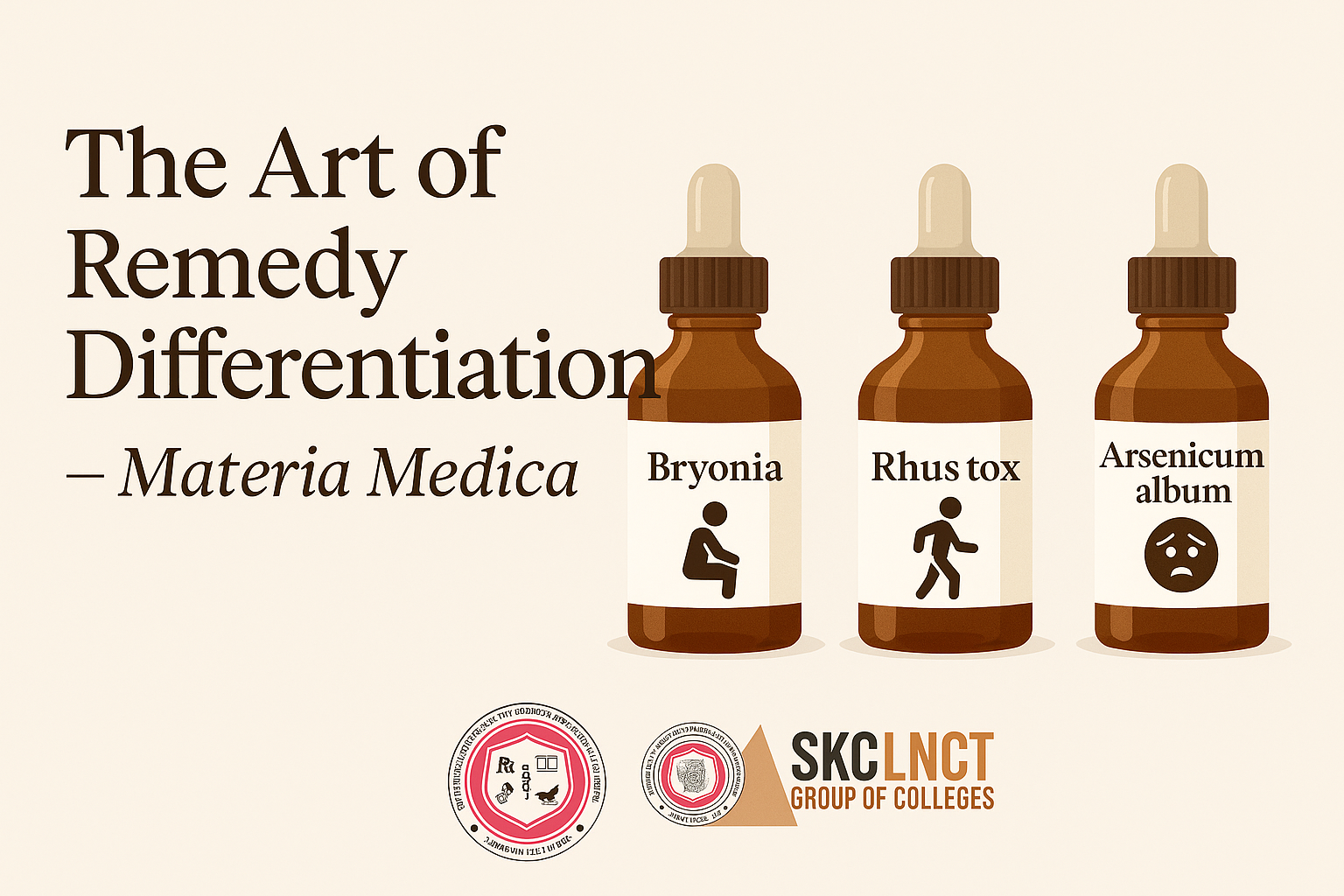
For instance, all three of these remedies — Bryonia, Rhus tox, and Arsenicum album — may help in fever or joint pain, but their expression differs:
- Bryonia: Dryness, thirst, wants to lie still, dislikes movement.
- Rhus tox: Restlessness, relief from movement, stiffness after rest.
- Arsenicum album: Anxiety, fear, thirst in sips, worse at midnight.
By learning the mental state, modalities, and characteristic symptoms, a student begins to recognize each remedy as a unique personality rather than just a list of symptoms.
🧠 Effective Techniques for Students
Here are some tried-and-true techniques to master Materia Medica:
- Visual Learning:
Use charts, remedy portraits, and mind maps. Visual associations help retain details better. - Remedy Comparisons:
Study remedies in pairs or groups — e.g., Pulsatilla vs. Sepia, Nux vomica vs. Coffea. This builds analytical thinking. - Story-Based Learning:
Treat every remedy like a person — what are their emotions, fears, reactions? For example, Ignatia feels grief deeply; Natrum mur hides it behind silence. - Clinical Observation:
Observe patients in OPD and try to match their temperament and symptoms to remedy pictures you’ve studied. - Group Study and Quiz:
Discuss remedies in small study circles. Peer discussions help in long-term retention.

🔬 Linking Materia Medica with Clinical Practice
A good homoeopath never prescribes mechanically. Understanding the remedy picture allows for individualized treatment.
In a clinical setting, when a patient presents with insomnia, the student must analyze:
- Is it due to overthinking? (Coffea cruda)
- Due to anxiety and restlessness? (Arsenicum album)
- Due to grief or emotional suppression? (Ignatia amara)
Such differentiation converts academic knowledge into clinical mastery.
🎯 Conclusion
Materia Medica is not just about knowing remedies — it’s about knowing humanity. It trains the student’s mind to see patterns in symptoms, emotions, and behavior. The deeper one studies remedies, the better one understands life itself.
So, to truly master Materia Medica, don’t just study the book — study the person behind the symptoms. Every remedy is alive, waiting to be understood.
🩺 Key Takeaway
“When you study Materia Medica deeply, you don’t just learn about medicine — you learn about people.”